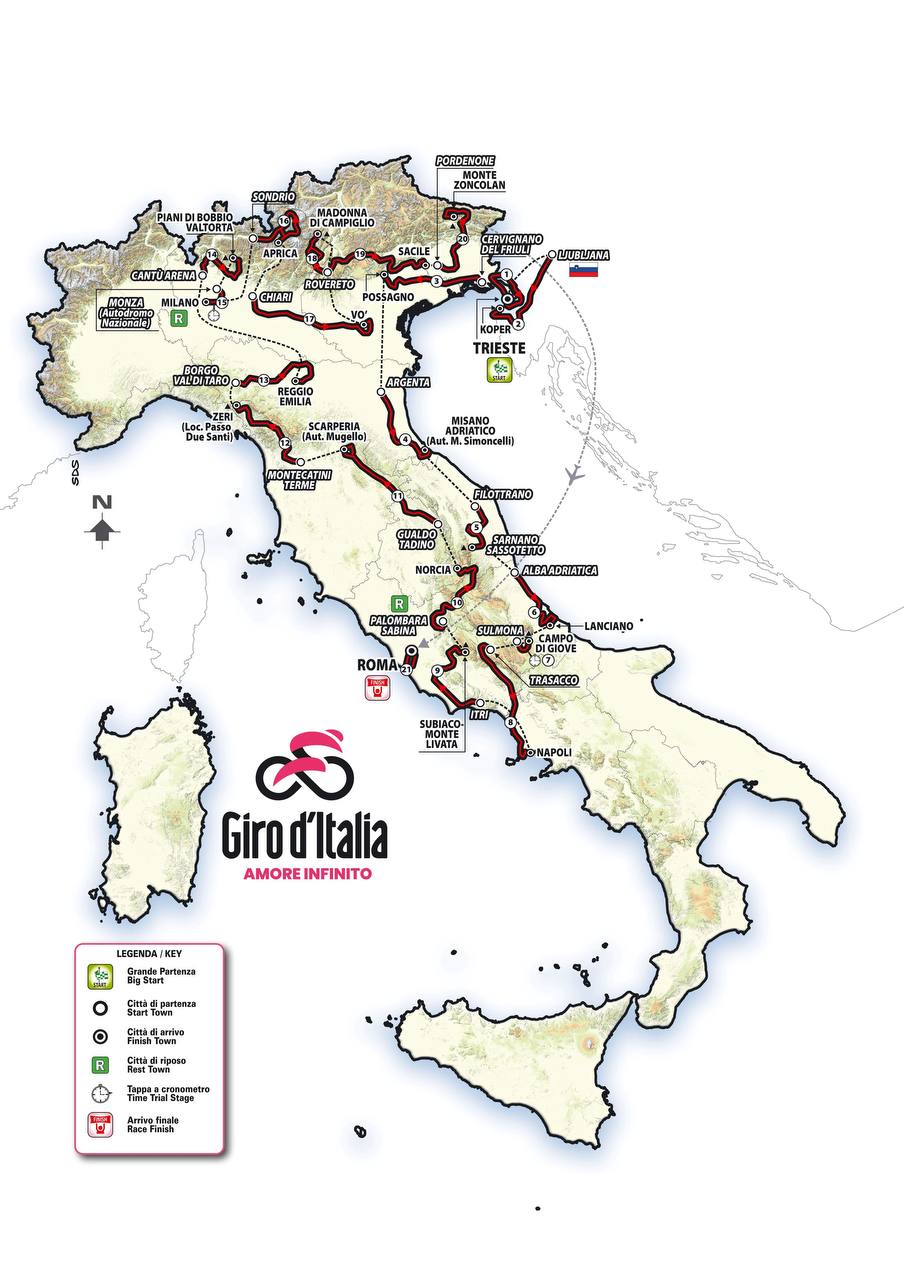
The route for the 110th Giro d’Italia is out, and it leaves little doubt about what kind of race RCS Sport wants in May 2027: one decided in the mountains, with some of the hardest climbs in Italian cycling packed into the final week. The race runs from Trieste to Rome between 8 and 30 May, covering 3,418.9 kilometres and climbing a combined 50,250 metres across 21 stages.
The presentation, held in Rome, marked the debut of Luca Guercilena, the former Lidl-Trek team manager who now oversees the Giro and the rest of RCS Sport’s cycling calendar as the organisation’s general director. During the unveiling, Guercilena explained the thinking behind the route: “Volevamo fare un Giro per corridori veri, con salite iconiche che restano nel cuore” (“We wanted a Giro for real riders, with iconic climbs that stay in the heart”).
Slovenia, sprinters and an early time trial
After two editions starting abroad, the Giro returns to Italian soil, though not without a European detour: the opening stage starts and finishes in Trieste but dips briefly into Slovenia, while stage two runs entirely between Ljubljana and Koper. The first genuine test for the overall contenders comes on stage five, into Sarnano-Sassotetto, before a 19.6km individual time trial from Sulmona to Campo di Giove adds an early selection among the climbs.
The race heads north in its second week, with uphill finishes at Zum Zeri and Piani di Bobbio, the latter preceded by a pass through the historic Madonna del Ghisallo. A 37.3km time trial between the Monza circuit and Milan closes the week, the longest against the clock in this edition and a clear opportunity for specialists to erase ground lost in the hills.
Two trips up the Mortirolo and a date with the Gavia
The queen stage arrives on 25 May, right after the second rest day: 192 kilometres from Sondrio to Aprica with roughly 5,700 metres of elevation gain. The route tackles the Mortirolo twice, with the Passo Gavia sandwiched between the two ascents. At 2,618 metres, the Gavia will stand as the Cima Coppi of this Giro, the race’s highest point, and its late-May altitude always carries some risk of snow or cold disrupting the stage.
Two days later, Madonna di Campiglio hosts another summit finish loaded with climbs, before the organisers save their sharpest weapon for the penultimate day. On 29 May, stage 20 finishes atop Monte Zoncolan after 180 kilometres from Pordenone, climbing the feared Ovaro side: 10.1 kilometres averaging 11.9%, with ramps far steeper in parts. That specific side of the mountain has not featured since 2018, when Chris Froome won there en route to overall victory. The Zoncolan itself, via its other approach from Sutrio, last appeared more recently, in 2021, when Lorenzo Fortunato took the stage.
From there it is a transfer to Rome, where the race concludes for a fifth consecutive year on 30 May.
Who might show up
Speculation around start lists has already begun. Jonas Vingegaard won the 2026 edition, and Tadej Pogačar lifted the maglia rosa in 2024, but neither has confirmed his 2027 calendar, and some reports suggest both may prioritise other goals next season. The two time trials could tempt Remco Evenepoel, while the sheer weight of climbing makes the route appealing on paper for riders like Paul Seixas or Isaac del Toro. Whoever lines up in Trieste will need to climb with the best, hold his own against the clock, and still have legs for a final week built around the Mortirolo, the Gavia and the Zoncolan.